How to Protect Your Identity as an Online Content Creator
If there is one concern that stops more people becoming online creators than any other, it is privacy.
Many people are perfectly comfortable with the creative side of running an online business. They enjoy photography, video, writing or building a community. What makes them hesitate is a much simpler question.
"What if somebody I know finds me?"
It could be a family member. A friend. A work colleague. A neighbour. Even an old school friend they have not spoken to for years.
That single fear prevents countless people from ever taking the first step.
The reassuring news is that protecting your identity is rarely about luck. It is about reducing risk through careful planning, sensible habits and understanding how information is connected online. While no system can ever promise complete anonymity, you can make it dramatically harder for your personal and creator lives to overlap unintentionally.
The earlier you understand those principles, the easier they are to build into your everyday routine.
Good privacy allows you to focus on creating instead of constantly worrying about being discovered.
Can you really stay anonymous online?
This is one of the most common questions new creators ask, and it deserves an honest answer.
The internet often presents two extreme opinions. One says complete anonymity is impossible. The other claims that a few simple tricks will make you invisible.
Neither is entirely true.
Privacy is better thought of as a spectrum rather than an on-or-off switch. Every sensible decision you make removes another opportunity for information to be connected. Every shortcut you take creates another possible route back to your real identity.
Imagine trying to complete a jigsaw puzzle.
If someone only has one piece, they know very little. Give them another piece, then another, and eventually the picture begins to appear. Your name, email address, social media accounts, photographs, location data, contact lists and browsing habits are all small pieces of that puzzle.
On their own, many reveal very little.
Together, they can reveal far more than you ever intended.
Understanding this changes the way you think about privacy. Instead of asking, "Is this one thing safe?" you begin asking, "Does this decision reveal another piece of the puzzle?"
That mindset leads to much stronger long-term habits.
Why our brains often underestimate privacy risks
One reason privacy mistakes are so common is that our brains are not particularly good at spotting slow, cumulative risks.
Psychologists call this normalisation. When we repeat an action many times without seeing an immediate negative consequence, we naturally begin believing the action is safe.
Perhaps you use the same email address for several accounts.
Nothing happens.
Later you connect your personal phone number to another service.
Still nothing happens.
A few weeks later you reuse the same username somewhere else.
Again, everything appears fine.
Each decision seems harmless because nothing bad happens immediately.
The problem is that privacy leaks usually develop gradually rather than suddenly. Information builds over weeks, months or even years until enough pieces become connected to identify someone.
This is why experienced privacy professionals tend to think in terms of reducing opportunities rather than reacting to individual problems.
Good privacy is proactive, not reactive.
The biggest misconception about online privacy
Many people assume hackers are the greatest threat to their anonymity.
In reality, the vast majority of identity leaks happen through perfectly ordinary behaviour.
Reusing an email address.
Uploading a photograph containing hidden location information.
Allowing apps unnecessary permissions.
Linking personal and business accounts.
Using the same profile picture across multiple websites.
Mentioning your workplace in one place and your town in another.
None of these actions feels especially dangerous on its own.
The problem is that modern search engines, social media platforms and online services are exceptionally good at connecting information that humans would never think to compare.
Computers do not become tired. They do not overlook patterns. They simply compare data.
The more information you accidentally give them, the easier that job becomes.
Your creator identity should be treated like a separate business
One of the simplest ways to improve your privacy is also one of the most effective.
Stop thinking of your creator profile as another social media account.
Instead, think of it as a completely separate business.
Businesses have their own branding.
Their own email addresses.
Their own records.
Their own workflows.
Their own equipment in many cases.
Once you begin thinking this way, better privacy decisions become much easier because you naturally start asking different questions.
Should this account use my personal email?
Should I be logged into my personal social media on the same browser?
Should my business files be mixed with family photographs?
Should subscribers be able to discover my personal profiles?
Viewing your creator work as a separate business naturally encourages healthy boundaries that benefit both your privacy and your organisation.
It also makes day-to-day decision making much simpler because the answer often becomes obvious.
Think about separation, not secrecy
Many people hear the word "privacy" and immediately imagine hiding.
That is not what good privacy is about.
Good privacy is about creating appropriate separation between different parts of your life.
Think about a doctor.
Their patients know them professionally, but they are unlikely to know where they spend every weekend, who their relatives are or which supermarket they use.
That is not secrecy.
It is simply a healthy professional boundary.
The same principle applies to creators.
Your audience can enjoy your work without needing access to your personal relationships, your family, your home address or your everyday life.
Creating those boundaries protects everyone involved, including the people around you who never chose to have an online presence.
Many privacy problems do not begin with a dramatic mistake. They begin with information that simply does not feel important at the time.
Imagine reading a newspaper interview with someone. One article mentions they live in a particular city. Another says they have a golden retriever. A third mentions they work in healthcare. A fourth reveals they enjoy climbing and support a particular football team.
None of those details identifies a specific person on its own.
Combined, they narrow the possibilities remarkably quickly.
The same thing happens online.
Perhaps one social media profile mentions your first name. A photograph accidentally shows the logo of your local gym. A public post celebrates a promotion at work. A casual livestream reveals the view from your window.
Your audience may never connect those details together.
Unfortunately, somebody who already knows you only needs one or two familiar clues before they begin wondering whether they have found the right person.
This is why privacy is not just about protecting obvious information such as your address or telephone number. It is also about thinking carefully before sharing details that, over time, create a recognisable picture of your everyday life.
Metadata: the information you cannot see
One of the least understood aspects of online privacy is metadata.
Metadata is simply information about a file rather than the file itself.
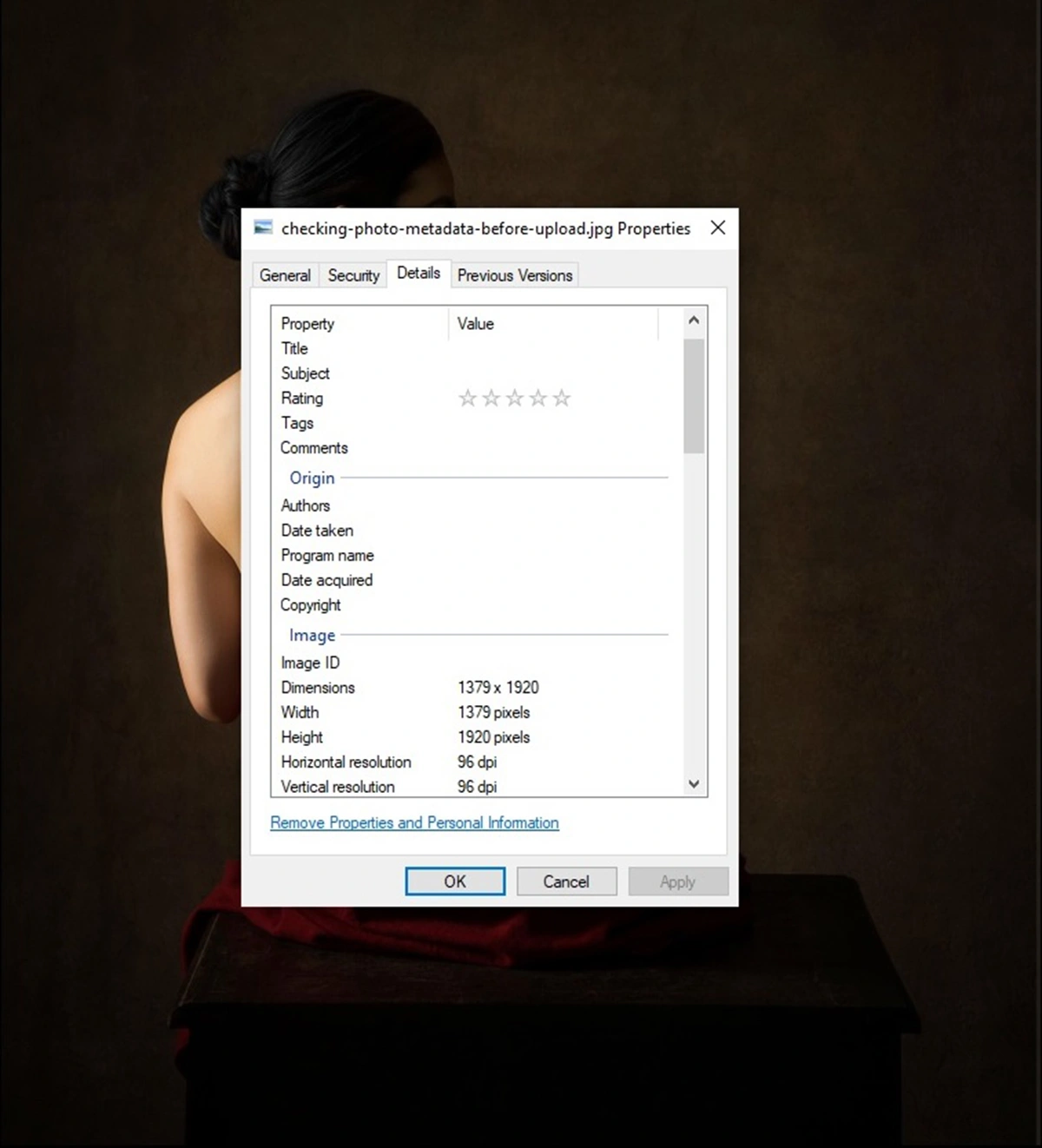
A photograph, for example, may contain details about when it was taken, which device captured it, camera settings and, in some circumstances, the location where it was recorded.
Most people never see this information because their phone or computer hides it from view.
Hidden information inside files can sometimes reveal more than expected.Modern platforms often remove much of this metadata when you upload content, but not every service behaves the same way, and you should never assume that hidden information has been stripped away automatically.
The safest approach is to treat metadata as something that deserves attention rather than blind trust.
The same applies to documents, screenshots and other files that may contain hidden information without you realising it.
This is one reason professional workflows often include dedicated steps for preparing media before it is published. Rather than relying on luck, they reduce the chance of unnecessary information travelling with the file.
Location data reveals more than your address
Many people assume location privacy simply means hiding their home address.
The reality is much broader.
Suppose you regularly post photographs taken in the same café every Tuesday morning. You mention going swimming every Thursday evening and occasionally share pictures from a local walking trail.
None of those locations is your home.
However, together they begin creating a predictable routine.
Humans are remarkably good at recognising patterns, especially when those patterns involve places they already know.
Behavioural scientists often refer to this as pattern recognition. Our brains evolved to detect routines because they helped our ancestors understand their environment. Today, the same ability allows people to identify surprisingly small clues about someone else's life.
That does not mean you should never leave the house with a camera.
It simply means asking yourself a sensible question before sharing something.
"Does this reveal more about my routine than I intended?"
Small habits become automatic habits
The good news is that privacy does not usually require complicated technical knowledge.
Most effective privacy practices are surprisingly ordinary.
You pause before uploading a photograph.
You check whether the background contains anything revealing.
You avoid mixing personal and business accounts.
You review your privacy settings every so often.
You think before you share.
These actions only take moments.
The real benefit comes from repetition.
Neuroscience tells us that repeated behaviours gradually become automatic through a process known as habit formation. Once a routine becomes familiar, your brain performs much of it with very little conscious effort.
That is why building good habits early is so valuable.
Instead of relying on memory every time you upload content, privacy gradually becomes part of your normal workflow.
Why convenience often works against privacy
Convenience features often connect more information than people realise.Technology is designed to remove friction.
Apps encourage you to log in with existing accounts. Browsers offer to remember passwords. Phones automatically synchronise photographs across multiple devices. Contact lists are uploaded to help you find people you know.
These features are undeniably convenient.
They are also designed with convenience as the priority rather than separation.
When everything connects automatically, it becomes much easier for personal and professional information to overlap without you noticing.
This is not because technology is inherently unsafe.
It is because convenience and privacy often pull in opposite directions.
The easiest option is not always the most private option.
Taking a few extra minutes to configure accounts carefully at the beginning can save a great deal of worry later.
Protecting your confidence as well as your identity
Privacy is often discussed as though it is purely a technical subject.
In reality, it has a significant psychological effect as well.
When you are constantly wondering whether somebody might recognise you, your attention becomes divided. Part of your brain stays alert, scanning for possible problems instead of concentrating on the creative work in front of you.
Psychologists sometimes refer to this as a heightened state of vigilance. Your mind continues monitoring for potential threats even when none are immediately present.
Over time, that constant background awareness becomes mentally exhausting.
Good privacy practices reduce much of that unnecessary cognitive load.
Instead of repeatedly asking yourself whether you have forgotten something important, you can work with greater confidence because you know your systems have been designed carefully from the start.
That peace of mind is often one of the greatest benefits of investing time in privacy before it becomes an urgent problem.
When your audience grows, your privacy becomes more valuable
Many creators assume privacy matters most at the beginning of their journey. In reality, it often becomes even more important as your audience grows.
A larger audience means more people viewing your content, sharing your work and interacting with your public profile. The overwhelming majority will simply enjoy what you create and move on.
However, as your visibility increases, so does the chance that someone will notice a small detail that others overlooked.
That is why strong privacy is much easier to maintain than it is to rebuild.
Once personal information has spread across the internet, removing every copy can be extremely difficult. Search engines cache pages, websites archive content and screenshots can circulate long after the original post has been deleted.
Building careful habits from the beginning is far easier than trying to undo years of accidental oversharing.
Privacy is an ongoing process, not a one-time task
Many people treat privacy like a checklist.
They review a few settings, create an account and assume the job is finished.
Unfortunately, the internet does not stand still.
Platforms introduce new features. Apps request new permissions. Security settings change. Services merge with other companies. Devices receive software updates that alter how information is shared.
Good privacy therefore becomes part of your normal business routine rather than a task you complete once and forget.
You do not need to spend hours reviewing everything every week.
Instead, build simple review points into your schedule. Every few months, take a little time to check your account settings, review connected devices, confirm that your contact information is still appropriate and remove anything you no longer use.
These small reviews rarely take long, but they help prevent minor issues gradually becoming much larger ones.
Knowing when to ask for help
There is another mistake that many new creators make.
They believe they have to understand every aspect of privacy themselves before they can work safely.
That expectation is unrealistic.
Most people are not networking specialists, cybersecurity professionals or digital forensic investigators. Nor do they need to be.
Understanding the principles is important because it helps you make sensible decisions and recognise potential risks.
Implementing every technical detail, however, is a very different challenge.
A well-designed privacy system involves far more than changing a few settings. It often includes secure file handling, structured workflows, protected storage, account separation, careful media preparation and ongoing reviews as platforms evolve.
Those systems take time to build properly and even longer to maintain.
For many independent creators, the real value lies in understanding why these protections matter while allowing experienced systems and proven processes to handle much of the technical complexity behind the scenes.
Confidence comes from preparation, not luck
Strong privacy comes from consistent preparation rather than hoping nothing goes wrong.People often talk about confidence as though it is a personality trait.
In reality, confidence usually grows from preparation.
Pilots follow checklists before every flight.
Surgeons follow procedures before every operation.
Professional photographers check their equipment before every important shoot.
None of these people relies on hope.
They rely on systems.
The same applies to protecting your identity online.
When you know your accounts have been separated carefully, your files have been prepared properly and your routines have been designed with privacy in mind, you spend far less time worrying about what might go wrong.
Instead, your attention returns to the reason you started your creator business in the first place.
Creating.
Learning.
Growing.
Final thoughts
Protecting your identity is not about becoming invisible.
It is about deciding which parts of your life belong in your business and which should remain private.
That distinction gives you control.
The strongest privacy strategies are rarely built around complicated technology alone. They come from good habits, thoughtful planning and recognising that every small decision contributes to the bigger picture.
If you approach your creator business as a separate professional venture, build sensible routines from the beginning and review them regularly, you will have already reduced many of the most common privacy risks.
No system can remove every possibility, but good preparation dramatically shifts the odds in your favour.
The aim is not to eliminate every risk.
It is to give yourself the confidence to create, knowing you have taken sensible, practical steps to protect both your personal life and your peace of mind.
Good privacy is not about fear or secrecy. It is about giving yourself the freedom to build your creator business with confidence, knowing that your personal life remains under your control. The strongest protection comes from careful planning, sensible habits and systems that quietly work in the background every day.
If you'd like some help putting these ideas into practice, I'd be happy to help. Complete the application form and, if it looks like I'm the right person to help, I'll get in touch for a friendly, no-obligation chat.
Zen Promotions is an independent creator growth partner based in Portsmouth, UK.
This site uses essential cookies to keep forms secure, maintain site functionality, and remember your cookie preferences. No advertising or behavioural tracking cookies are used.