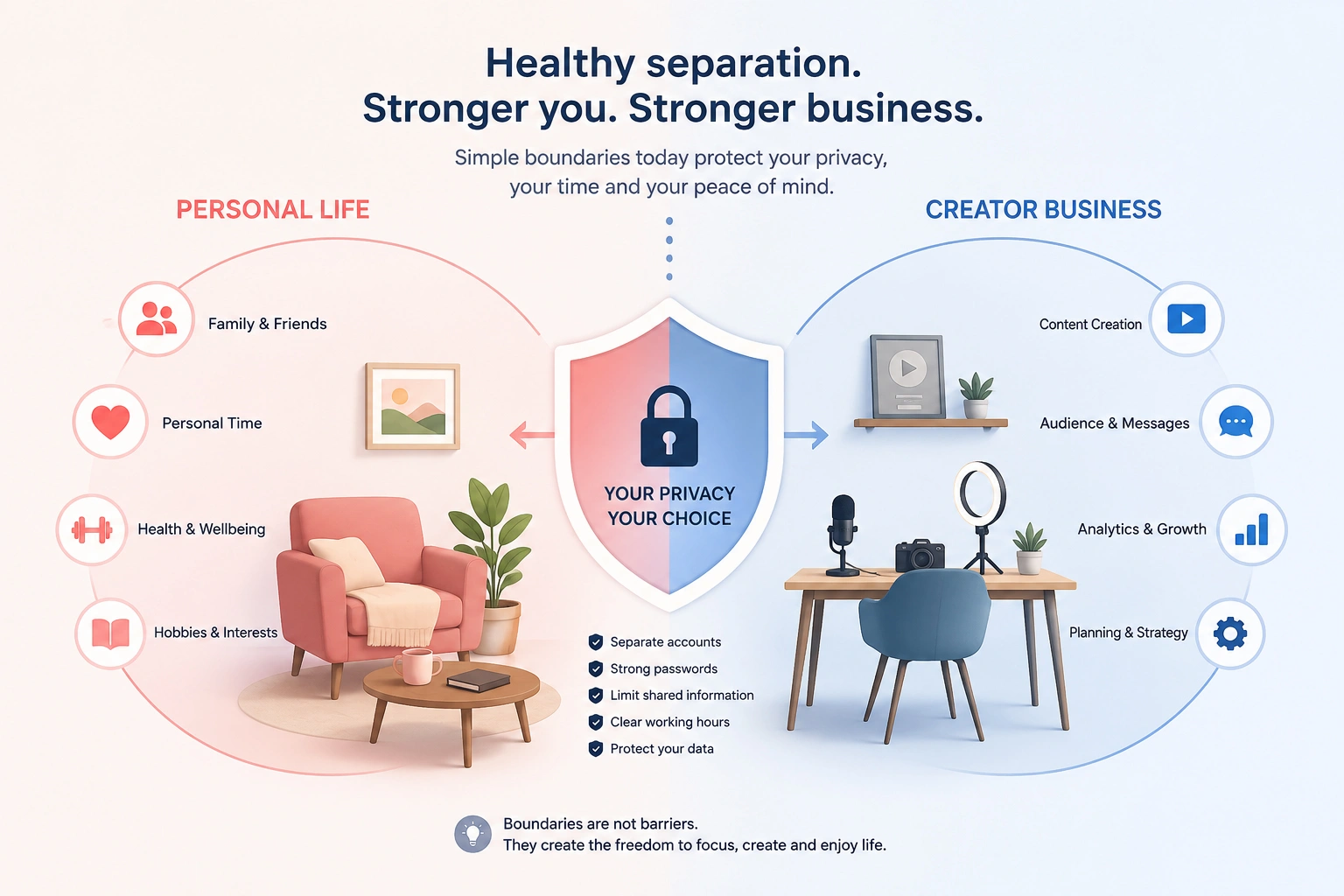
How to Keep Your Personal and Creator Life Separate
Choosing to build an online creator business can be an exciting step. It offers flexibility, creative freedom and the opportunity to build something around your own schedule. For many people, that sense of independence is one of the biggest reasons they are attracted to this type of work.
Ironically, that freedom is also one of the easiest things to lose.
Unlike a traditional workplace, there is no physical office to leave at the end of the day. Your creator business exists on the same devices you use to message friends, browse social media, watch videos and stay connected with the people around you.
Without meaning to, work can begin following you everywhere.
A notification appears while you are watching television.
A message arrives while you are having dinner.
You remember an idea for tomorrow's content just as you are trying to fall asleep.
None of these moments seem particularly serious by themselves. The problem is that they slowly build a pattern. Over time, your brain starts learning that it should always be available, always paying attention and always ready to switch back into work mode.
Eventually, you may find yourself feeling as though you are never completely away from your business.
For many creators, this gradual loss of separation becomes more exhausting than the creative work itself.
A healthy creator business should fit around your life, not replace it.
Why separation matters more than most people realise
When people think about protecting their privacy as a creator, their first concern is often very specific.
"Will someone I know discover my creator profile?"
That concern is completely understandable. Friends, family members, colleagues and people from your past may all be part of your everyday life, and wanting control over who sees your work is a reasonable boundary.
However, privacy is only one part of keeping your personal and creator life separate.
The bigger picture is about protecting your time, your relationships, your confidence and your mental energy.
When personal and business activities become mixed together, everything begins competing for your attention.
Work interrupts family time.
Notifications interrupt conversations.
Ideas about content interrupt moments that should be relaxing.
Instead of your business being something you choose to spend time on, it can start feeling like something that is constantly waiting for you.
This is where many independent creators experience a difficult shift.
The business that originally represented freedom begins creating pressure.
A healthy separation creates the opposite effect.
When you are working, you can focus properly.
When you are resting, you can genuinely switch off.
That distinction might seem small, but it has a major effect on how sustainable your business feels over months and years.
Think like a business owner, not just a creator
One of the most useful mindset changes is to stop viewing your creator profile as simply another social media account.
Instead, think of it as a small business.
Businesses naturally have structure.
They have working hours.
They have systems.
They have processes for keeping information organised.
Most importantly, they have boundaries.
Imagine somebody opening a café.
They would not expect to serve customers twenty-four hours a day. They would decide when the doors open, when they close, how supplies are managed and when administration gets completed.
An online creator business deserves the same level of thought.
The fact that your business happens digitally does not mean it should have unlimited access to your personal life.
You decide when you work.
You decide when you are unavailable.
You decide how your business fits around your existing responsibilities.
Those decisions are much easier to maintain when they are made deliberately from the beginning.
Without clear boundaries, your routine will often be shaped by whichever task feels most urgent at that moment.
A message arrives, so you reply.
A notification appears, so you check.
A new idea comes into your head, so you stop what you are doing to write it down.
None of those actions are wrong individually. The problem is when they become the default way you operate every day.
How blurred boundaries affect your brain
Many creators assume that being constantly connected simply means they are being productive.
In reality, constant connection creates a hidden mental cost.
Your brain is designed to focus on one type of activity at a time. Every time you switch from personal life to business, your mind has to adjust.
You move from watching a film to answering messages.
You move from spending time with friends to planning content.
You move from relaxing in bed to thinking about tomorrow's schedule.
This repeated switching creates what psychologists call attention residue.
Attention residue means that part of your mind continues thinking about a previous task even after you have moved onto something else.
For example, you might put your phone down after replying to messages, but part of your attention remains focused on the conversation. You may still be thinking about what to say next, whether you replied correctly or whether another message will arrive.
The more frequently this happens, the harder it becomes to be fully present.
This is one reason why people can feel exhausted after a day where they have not completed a huge amount of obvious work.
Their brain has been constantly switching environments.
They have been using energy not just completing tasks, but repeatedly changing mental gears.
Creating boundaries reduces this unnecessary strain.
It allows your brain to enter deeper focus when you are working and proper recovery when you are not.
Small habits can slowly remove your boundaries
Creating clear boundaries helps your mind switch between work and rest.The loss of separation between personal and creator life rarely happens overnight.
Usually, it begins with small habits that seem harmless.
Perhaps you check notifications while waiting in a queue.
Then you answer one message before going to sleep.
A few days later, you spend your lunch break organising files.
Eventually, you realise that your creator business has expanded into every spare moment of your day.
The difficult part is that each individual action feels reasonable.
You are not spending hours working.
You are only checking something quickly.
You are only replying to one person.
You are only making one small adjustment.
However, these small interruptions teach your brain to remain permanently alert.
Instead of having clear periods of work and rest, you create a state where both are happening at the same time.
You are physically relaxing, but mentally still working.
You are spending time with people, but part of your attention is somewhere else.
You are trying to enjoy your evening, but your brain is still monitoring your business.
This is why boundaries are not just about time management.
They are about protecting your ability to properly experience both sides of your life.
Your creator business deserves your attention when you are working on it.
Your personal life deserves your attention when you are away from it.
Keeping those two spaces separate allows both to benefit.
Your business should support your life
Many people begin a creator business because they want more control over their time.
Perhaps they want greater flexibility around family commitments.
Perhaps they want an additional source of income.
Perhaps they simply enjoy creating content and want to build something that belongs to them.
Whatever the reason, it is important to remember that the business exists to support your life.
Your life should not gradually become something that only exists around your business.
This shift can happen slowly because growth often feels positive at first.
You gain subscribers.
You receive more messages.
You have more ideas.
You feel motivated because your efforts are starting to produce results.
However, without clear boundaries, success can create its own problems.
A quiet evening becomes a work session.
A weekend becomes a catch-up period.
A holiday becomes an opportunity to organise content.
Again, none of these choices are automatically wrong. There will always be times when you choose to put extra effort into something important.
The issue is when those choices stop feeling like choices.
When you begin feeling unable to step away, your business has started controlling your routine rather than fitting into it.
A sustainable creator business is not built by maximising every available hour.
It is built by creating systems that allow you to use your time intentionally.
Privacy begins with everyday decisions
When people think about online privacy, they often imagine complicated technology or advanced security knowledge.
The reality is usually much simpler.
Many privacy issues happen because ordinary decisions are made without considering how they connect together.
Using the same email address everywhere.
Linking personal accounts because it is convenient.
Allowing creator activity and personal activity to happen on the same devices without clear separation.
Sharing information publicly without considering how it could be combined with other details.
None of these decisions seem significant in isolation.
The challenge is that information builds a picture over time.
A single detail may not reveal much. Multiple small details combined together can create unexpected connections.
Good privacy is therefore rarely about one perfect security measure.
It is about reducing unnecessary links between different areas of your life.
This is why privacy habits are most effective when they are built early.
It is much easier to create separation before your business becomes established than it is to untangle years of overlapping accounts, files and routines later.
Privacy is built through many small decisions rather than one single solution.
Separate your working time from your personal time
One of the biggest challenges with online businesses is that they never completely disappear.
There is no office door to close.
There is no physical journey home.
There is simply a device sitting nearby that gives you instant access whenever you choose to use it.
That convenience is useful, but it also creates a temptation.
You start believing that being available more often must mean being more successful.
In reality, constant availability often creates the opposite result.
When your day is filled with small interruptions, it becomes harder to complete important tasks properly. You spend more time reacting and less time planning.
This creates a cycle:
You become interrupted.
You fall behind.
You feel pressure.
You check your accounts more frequently.
You become even more interrupted.
Breaking this cycle usually requires creating clear periods for different activities.
For example, you might decide that certain times are for content creation, certain times are for administration, and certain times are completely personal.
The exact schedule will be different for everyone.
The important thing is not the specific hours.
The important thing is creating a predictable pattern that your brain can rely on.
Do not let guilt control your routine
One of the most difficult parts of running an independent creator business is managing guilt.
Many creators experience thoughts such as:
"I should reply faster."
"I should be creating more."
"I should check my account just in case."
"I should not take this evening off."
This type of thinking is understandable.
When you are responsible for your own success, it can feel as though every moment away from work is a missed opportunity.
However, guilt often encourages short-term reactions rather than good long-term decisions.
You log in for five minutes.
You check one notification.
You answer one message.
Suddenly, half an hour has passed.
The problem is not that you spent thirty minutes working.
The problem is that your brain never received permission to properly rest.
Rest is not the opposite of productivity.
It is part of productivity.
A rested person generally makes better decisions, has more creative ideas and manages challenges more effectively than someone who is constantly exhausted.
Your audience is following a real person.
They do not need you to be available every minute of every day.
Professionalism does not mean unlimited access.
Professionalism means creating reliable systems and communicating in a way that you can maintain.
Your relationships deserve protecting too
A creator business should add something positive to your life.
It should not gradually replace the parts of life that made you want more freedom in the first place.
When work begins interrupting meals, conversations or time with friends and family, it is worth reviewing whether your boundaries have started to weaken.
The people around you should not feel as though they are competing with your phone for your attention.
Likewise, you deserve moments where you can enjoy your life without feeling that you should be doing something else.
Going for a walk.
Watching a film.
Spending time with people you care about.
Having an evening where you do absolutely nothing productive.
These are not wasted moments.
They give your mind the opportunity to recover.
Interestingly, stepping away from work can often improve creativity. When your brain is not constantly focused on solving problems, it has space to make new connections and generate fresh ideas.
Sometimes the best ideas appear when you stop trying to force them.
Good boundaries lead to better decisions
Another hidden benefit of separating work and personal life is reducing decision fatigue.
Every day, your brain makes thousands of decisions.
Most are small.
What should I do next?
Which task matters most?
Have I replied to everyone?
Should I create something today or organise my files?
Individually, these choices are manageable.
The problem is when hundreds of small decisions accumulate without any structure.
Decision fatigue occurs when the amount of mental effort required to keep choosing begins to reduce your ability to make clear decisions.
This can leave you feeling tired, frustrated and unsure, even when no single task is particularly difficult.
Good systems reduce this problem.
When you have established routines, you remove many unnecessary choices.
You no longer have to constantly decide when to work, what to organise or whether you should be checking your accounts.
The system has already answered those questions.
That leaves more mental energy for the parts of your business where your creativity and personality matter most.
Professional does not have to mean complicated
Some people assume that creating a professional workflow requires expensive software, advanced technical knowledge or complicated systems.
It does not.
Professionalism usually comes from consistency rather than complexity.
Simple habits followed regularly are often more valuable than complicated systems that become too difficult to maintain.
Keeping information organised.
Creating repeatable routines.
Reviewing your processes occasionally.
Knowing where important files and information are stored.
These small improvements make a significant difference over time.
The goal is not to create a perfect system.
The goal is to create a system that works for your actual life.
A simple structure that you follow consistently will almost always outperform a complicated structure that becomes another source of stress.
As your business grows, so does the hidden workload
One of the biggest surprises for many creators is how quickly the work behind the scenes begins to grow.
Creating content is only one part of running a creator business.
Behind every piece of content sits a collection of smaller responsibilities:
Organising files.
Planning future content.
Keeping track of what has already been posted.
Managing account settings.
Reviewing performance.
Maintaining communication.
Protecting personal information.
Individually, these tasks are rarely difficult.
The challenge is that they all compete for the same limited resource.
Your attention.
This is why many creators reach a point where they feel busy all the time, even though they cannot identify one specific task causing the problem.
The workload has not necessarily become harder.
There is simply more happening at once.
This is also why good organisation becomes increasingly valuable as a creator business develops.
A clear workflow does not just save time. It reduces the number of decisions you need to make every day.
Instead of constantly asking yourself:
"Where did I save that file?"
"Have I already used this content?"
"When should I post this?"
"What still needs to be done?"
You create a structure that answers those questions before they become problems.
That reduction in mental clutter makes it much easier to protect the separation between your work and personal life.
Know when doing everything yourself stops being efficient
Protecting personal time is part of building a sustainable business.There is a common belief that successful independent creators should handle every part of their business personally.
At the beginning, this makes sense.
You are learning.
You are discovering what works.
You are building confidence in your own systems.
However, there comes a point where trying to control every single detail can become the thing slowing your growth down.
This does not mean you are incapable.
It means your time has become valuable.
A creator's most important assets are usually the things that cannot be copied:
Your personality.
Your creativity.
Your connection with your audience.
Your understanding of your own brand.
Those are the areas where your attention has the greatest impact.
Administrative tasks, organisation, scheduling and technical processes are important, but they do not always require the same level of personal involvement.
Many successful businesses grow by creating better systems around the important work, not by simply asking one person to do more and more.
Recognising when support or improved systems would help is not a sign that you have failed.
It is often a sign that your business has reached a new stage.
Understanding the difference between control and responsibility
One reason people struggle with separation is because they confuse responsibility with doing everything personally.
As the owner of your creator business, you are responsible for the decisions that shape it.
You decide your boundaries.
You decide your goals.
You decide what feels right for you.
However, responsibility does not mean every task must sit on your shoulders forever.
A business owner does not become less responsible because they use tools, systems or support.
A restaurant owner is still responsible for the quality of the food even though they do not personally wash every plate.
A photographer is still responsible for their work even if they use editing software.
A business owner is still responsible for their vision even when parts of the operation are supported by others.
The same principle applies to creator businesses.
The aim is not to remove yourself from your business.
The aim is to protect your time so you can focus on the parts where you create the most value.
Build boundaries before you need them
Many people only start thinking seriously about boundaries after they already feel overwhelmed.
By that stage, changing habits can feel much harder.
The good news is that boundaries do not need to be created perfectly from day one.
They can be developed gradually.
Start by noticing where your personal and business lives overlap.
Are notifications interrupting your evenings?
Are you checking messages during moments where you wanted to relax?
Are you spending more time organising your business than actually enjoying it?
These questions are not criticisms.
They are simply useful observations.
The earlier you notice patterns, the easier they are to adjust.
A sustainable creator business is not built by avoiding all effort.
It is built by making sure that your effort is directed intentionally rather than constantly reacting to whatever appears next.
Final thoughts
Keeping your personal and creator life separate is not about building a wall between yourself and your audience.
It is about creating healthy boundaries that allow both parts of your life to exist successfully together.
A creator business should give you more control, not quietly remove it.
The strongest foundations are usually built through simple decisions made consistently:
Creating clear working periods.
Protecting your personal time.
Keeping information organised.
Maintaining sensible privacy habits.
Building systems that reduce unnecessary stress.
You do not need to become an expert in productivity or technology overnight.
You simply need to become aware of where your time and attention are going, then make small improvements that support the life you actually want.
Over time, these small changes create something much more valuable than a busy schedule.
They create freedom.
When your business supports your life rather than controlling it, you give yourself a much stronger chance of building something sustainable for the future.
A successful creator business should fit around your life, not replace it. Clear boundaries, sensible routines and good organisation help protect your privacy, your relationships and the freedom that attracted you to creating in the first place.
If you'd like some help putting these ideas into practice, I'd be happy to help. Complete the application form and, if it looks like I'm the right person to help, I'll get in touch for a friendly, no-obligation chat.
Zen Promotions is an independent creator growth partner based in Portsmouth, UK.
This site uses essential cookies to keep forms secure, maintain site functionality, and remember your cookie preferences. No advertising or behavioural tracking cookies are used.