Why Facebook Reels Get Views but Don’t Convert | Creator Guide
Getting a Reel to take off can be incredibly exciting.
You post something that took you a few minutes to make, go about your day, and then discover that hundreds or thousands of people have watched it. Perhaps the numbers keep climbing. Comments start appearing. People are reacting to it. You may even gain a noticeable number of new followers.
It feels like something has finally clicked.
Then you look at the part of your business that actually matters to you.
Very little has changed.
Your audience has grown slightly, but not nearly as much as you expected. Your other pages have not suddenly filled with new visitors. The number of people taking the next step is disappointing compared with the number of people who watched the Reel.
It is easy to conclude that the views were somehow worthless.
They weren't.
The problem may be what happens after the view.
A successful Reel gets someone's attention. It does not automatically tell that person what to do next.
That distinction is incredibly important.
A Reel can be entertaining, attractive, funny or intriguing enough to make somebody stop scrolling. But if that person then visits your profile and cannot immediately see where to go, what you offer or why they should continue following you, the opportunity disappears almost as quickly as it arrived.
Think of your Reel as the shop window of a business on a busy high street.
The window can be beautiful. It can make people stop and look. It can even attract hundreds of people in a single afternoon.
But if nobody can find the door, very few people will ever walk inside.
That is the basic idea behind a leaky funnel.
Views are attention, not a result
One of the easiest mistakes to make is treating views as though they are the final goal.
They aren't.
A view simply tells you that somebody watched your content. Depending on how the platform counts views, that may represent anything from a very brief interaction to somebody who watched the entire Reel.
What matters for your wider business is what happens afterwards.
Someone might watch your Reel and keep scrolling.
Someone else might watch it, enjoy it and follow you.
Another person might visit your profile.
Another might read your bio, look through a few posts and decide they want to see more of what you create.
These are all different levels of interest.
The important thing is that you should not expect every viewer to reach the final stage. Most won't, and that is perfectly normal.
Instead, your job is to make each step as clear and easy as reasonably possible for the people who are genuinely interested.
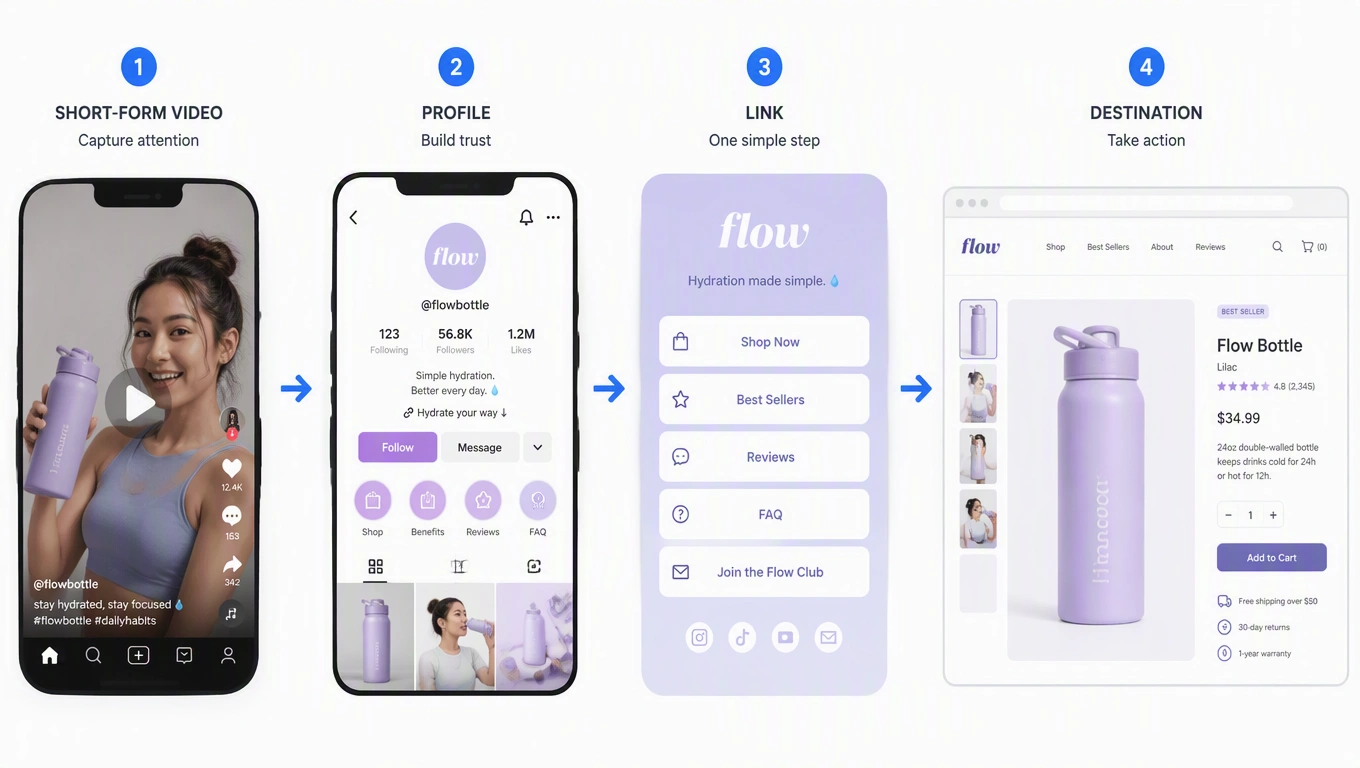
You can think of the journey like this:
A Reel creates attention. A clear journey gives that attention somewhere to go.
The Reel gets attention.
The profile gives context.
The bio explains what to do next.
The link provides a clear route.
The destination gives the visitor a reason to stay.
If one of those stages is confusing, the journey becomes harder.
That does not necessarily mean you need a completely different Reel.
Sometimes the Reel is doing its job perfectly well.
The leak is happening afterwards.
The two-second profile test
Imagine somebody has just watched one of your Reels.
They enjoyed it enough to tap your name.
They are now looking at your profile for the first time.
What do they see?
This is a useful question because you probably know your own profile far too well.
You know where everything is.
You know what the links mean.
You know what your username refers to.
You know what your pinned post is about.
A new visitor knows none of that.
They have arrived with almost no context.
Within a few seconds, they should be able to understand three basic things:
Who you are.
What they can expect from you.
Where they can go if they want to see more.
That does not mean filling your profile with huge amounts of text.
In fact, the opposite is usually better.
Your profile should make the next step obvious rather than making somebody work it out.
If your bio is vague, your most useful information is buried beneath several unrelated posts, and your main link is difficult to find, a curious visitor has to make decisions before they have developed much interest.
Every extra decision creates another opportunity for them to leave.
Your profile is part of the Reel
It is tempting to think of your Reel and profile as two completely separate things.
From the viewer's perspective, they are not.
The Reel creates the reason to visit your profile.
The profile needs to continue the experience.
This means your profile should feel like a natural extension of the content that brought the visitor there.
If your Reels have a particular personality, style or subject, your profile should reinforce that impression.
That does not mean every post needs to look identical.
It means there should be enough consistency that someone who arrives from a Reel can recognise that they have found the right person.
This is particularly important when your Reels are reaching people who have never seen you before.
A stranger does not have the same level of trust as an existing follower.
They are effectively asking themselves:
“Is this the person I just watched?”
“Is there more of this?”
“Is this profile worth following?”
“Where should I go next?”
Your profile should answer those questions without making the visitor hunt for the answers.
Give your bio a job
A bio is often treated as a tiny introduction.
It can do much more than that.
Your bio is one of the first places a new visitor looks when deciding whether to continue exploring. It therefore needs to work as a very small piece of navigation.
You do not need to explain your entire life.
You need to give the visitor enough information to understand what they have found and what they can do next.
For example, a useful structure might be:
A short description of what you create.
A reason to follow or explore further.
A clear indication of where to find more.
The exact wording will depend on your personality and the type of content you create.
The important point is that the bio should not make people guess.
“Welcome to my page” tells a visitor very little.
“New videos every week” gives them something useful.
“Behind the scenes and new updates here” creates a little more context.
The best wording is not necessarily the most clever wording.
It is the wording that a stranger understands immediately.
The one-click principle
Once someone has decided they want to see more, the next step should be straightforward.
This is where links become surprisingly important.
A common mistake is assuming that an interested person will happily search for you elsewhere.
They might.
Most won't.
If somebody has to remember your username, open another app, search for you, work out which account is genuine and then find the right page, you have turned a moment of curiosity into a small research project.
Most people will simply give up.
This is why a clean landing page or personal website can be so useful.
Rather than presenting a visitor with a confusing collection of destinations, you can provide one clear starting point.
From there, the visitor can choose where they want to go.
That could be a personal website, a multi-link page, another social profile, a mailing list or another appropriate destination.
The exact destination is less important than the principle.
Make the first step easy.
It is also worth remembering that platform rules change. A link that works today may be restricted, reviewed or treated differently in the future. Meta's systems are designed to detect behaviour and content that may create poor or unsafe experiences, and enforcement can affect how content or features are handled.
For that reason, it is sensible to build your traffic system around a clean, trustworthy route rather than repeatedly trying to find ways around platform restrictions.
Why a personal website can be more than a link
A multi-link page can be useful because it keeps several destinations in one place.
A personal website can take that idea much further.
Instead of simply saying:
“Here are my links.”
you can create an environment that tells visitors who you are, what you create and what they can expect.
That gives you much greater control over the experience.
It also gives you somewhere that is not entirely dependent on the layout or features of a social media platform.
This does not mean everyone needs a complicated website.
A simple, well-designed page with your name or creator identity, a clear introduction and a small number of useful destinations can be enough.
The important thing is not how technically impressive it is.
It is whether it helps an interested visitor take the next step.
Your cover image is valuable space
There is another part of the profile that is often overlooked.
The cover image.
It is one of the largest visual areas available on your profile, yet it is frequently treated as decoration rather than navigation.
A good profile should make the next step obvious without shouting for attention.You do not need to turn it into a giant advertisement.
In fact, that can make the profile feel less personal.
Instead, think of it as a sign above the entrance to a shop.
A clean image that reflects your identity can be combined with a small visual cue directing attention towards the relevant part of your profile.
The aim is not to shout.
It is to remove uncertainty.
If your main link sits underneath your bio, a visitor should be able to work out that it is there without needing instructions written in capital letters.
A simple visual hierarchy can do much of the work for you.
The pinned post can finish the job
Your profile does not have to rely entirely on the bio.
A pinned post can act as a second introduction for people who have arrived from a Reel.
This is particularly useful because a new visitor may want a little more information before clicking a link.
Your pinned post could explain what you create, introduce your personality, show a particularly good example of your content or simply give visitors a clear place to start.
Think of it as the friendly person standing just inside the door of a shop.
They are not following the customer around.
They are simply making it obvious where everything is.
The pinned post should therefore be useful rather than desperate.
You do not need to tell people repeatedly to click something.
Give them a reason to continue.
That distinction becomes increasingly important as you start thinking about the next part of the funnel: the call to action.
A Reel can attract attention.
Your profile can create interest.
But unless you give people a clear next step, many of them will simply disappear back into the feed.
And that is where an otherwise excellent Reel can quietly lose the opportunity it created.
Your Reel needs to lead somewhere
A good Reel can do several things at once.
It can entertain somebody.
It can make them curious.
It can show your personality.
It can introduce your style.
What it cannot do by itself is decide what the viewer should do next.
That is your job.
This does not mean every Reel needs to end with a loud sales message. In fact, constantly telling people to click something can make your content feel more like an advert than something they wanted to watch.
A better approach is to give interested viewers a simple direction.
Think about what you would say if somebody watched your Reel in person and then asked, “Where can I see more of this?”
Your answer would probably be straightforward.
You would tell them where to go.
Your Reel can do exactly the same thing.
The subtle call to action
A call to action, usually shortened to CTA, is simply an instruction that tells someone what you would like them to do next.
The phrase sounds more complicated than it is.
“Follow for more” is a call to action.
“Check my page” is a call to action.
“Which one do you prefer?” is a call to action because it encourages a response.
The mistake is thinking that a CTA has to sound like an advertisement.
It doesn't.A good CTA does not need to feel like an advertisement. It simply gives interested viewers somewhere to go.
For many creators, a natural CTA will work better when it feels like part of the content rather than something bolted onto the end.
For example, a Reel showing two different outfits could finish with a question asking which one people prefer.
A short behind-the-scenes clip could invite people to follow for more.
A series of related videos could encourage viewers to visit the profile to find the rest.
The exact wording matters less than the purpose.
Give the interested viewer somewhere to go.
Do not make the viewer guess
Imagine somebody watches your Reel and thinks:
“I really like her style. I wonder if she has more videos.”
They tap your profile.
Now what?
If there is no indication of what to do next, that person has to work it out.
Perhaps they scroll through your posts.
Perhaps they look for a link.
Perhaps they decide to search for you somewhere else.
Perhaps they simply return to their feed.
None of those outcomes means your Reel failed.
It means the next stage was not clear enough.
This is an important distinction because it changes how you diagnose the problem.
If a Reel is getting attention but very few people are moving beyond it, the answer may not be “make better Reels”.
It may be “make the journey after the Reel clearer”.
That is a much more useful question to ask.
Use the final seconds deliberately
The end of a short video is valuable.
You have already earned the viewer's attention, so there is an opportunity to give them a small amount of direction before they move on.
A simple text overlay can be enough.
For example:
More on my page
Follow for the next one
More behind the scenes on my profile
See what happens next on my page
These are only examples. Your wording should sound like something you would naturally say.
The important part is that the instruction is easy to understand.
You also do not need to cover the screen with text.
A short phrase appearing during the final moment of the Reel can be much more effective than a paragraph of instructions that the viewer has no chance of reading before the video ends.
The same principle applies to spoken CTAs.
If you are comfortable speaking to camera, a simple sentence can feel much more natural than a formal advertising message.
There is a difference between curiosity and confusion
Curiosity is one of the most useful tools available to a creator.
If someone finishes a Reel thinking, “I want to know what happens next,” you have created a reason for them to continue exploring.
But there is an important difference between creating curiosity and deliberately making something confusing.
A good curiosity gap gives the viewer enough information to understand why something is interesting while leaving them wanting a little more.
For example, you might show the preparation for something without showing the finished result.
You might introduce an unusual idea and promise to reveal the outcome later.
You might share part of a story while explaining that the rest is available elsewhere.
The viewer understands what they are being invited to discover.
Confusion is different.
If someone has no idea what your video is about, who you are or why they should care, they are unlikely to become more interested simply because information has been withheld.
The goal is not to hide information for the sake of it.
The goal is to give people a genuine reason to continue.
Do not give away the whole journey
There is another useful way to think about curiosity.
Your public content does not have to contain everything.
That does not mean deliberately making your free content poor.
Quite the opposite.
Your public content should be good enough that somebody can enjoy it without needing to do anything else.
The next step should offer something different rather than simply more of exactly the same thing.
Perhaps your public content shows your personality while your main page contains longer-form material.
Perhaps you share highlights publicly while keeping the full experience elsewhere.
Perhaps you show the beginning of a project and invite people to see how it develops.
Perhaps the value is simply having more regular access to you and your work.
This creates a much healthier relationship between public content and your destination.
The public content earns attention.
The destination gives interested people somewhere to invest that attention.
Your public content should stand on its own
There is a temptation to make public content feel deliberately incomplete so that people have to leave the platform.
That can easily go too far.
If every Reel feels like an advert for something else, people will eventually stop enjoying the Reels themselves.
Your public content should still be worth watching.
This is particularly important when your audience is discovering you for the first time.
A viewer should be able to enjoy a Reel without feeling that they have been manipulated into clicking something.
The best traffic systems therefore work in two directions.
The Reel provides value in its own right.
The profile offers another step for people who want more.
That is a much more natural relationship.
Be careful with links in comments
It is understandable why creators sometimes put their main link into the comments of a Reel.
It seems convenient.
The video remains visually clean, while anyone interested can supposedly find the link underneath it.
There are several problems with relying on this approach.
First, comments are not a stable navigation system.
As more people respond to your Reel, your comment can become harder to find.
Second, external links can receive different treatment from platform systems depending on the circumstances. A link that is visible to you is not necessarily going to provide the same experience to every viewer.
Third, asking someone to find a particular comment adds another step.
That may sound insignificant.
It isn't.
The more complicated the route becomes, the more opportunities there are for someone to give up.
Your profile is a much more sensible place to establish a consistent route.
If you want people to visit somewhere else, teach them where that route begins.
Do not turn every caption into an advertisement
Your caption has another important job.
It can give context to the Reel and encourage conversation.
It does not need to repeat your entire marketing message.
A caption such as:
Which one would you choose?
can be enough to start a conversation.
So can:
I wasn't sure about this one at first. What do you think?
or:
Should I do more videos like this?
Questions work particularly well because they give people something specific to respond to.
The key is authenticity.
If you ask a question purely because you have heard that questions increase engagement, your audience may eventually notice that every post follows exactly the same formula.
Instead, ask questions you would genuinely be interested in having answered.
That creates a much more natural relationship with your audience.
Engagement is not a magic button
You will often hear advice suggesting that comments, likes and shares automatically make a Reel successful.
The reality is more complicated.
Engagement is one part of how social platforms understand the response to content, but there is no single trick that guarantees wider distribution.
This matters because chasing engagement at any cost can produce poor content.
For example, repeatedly asking deliberately meaningless questions may produce comments without creating any genuine interest in you.
A hundred comments from people who never remember your name are not necessarily more valuable than a smaller number of people who genuinely want to see more of your work.
Think beyond the number.
Ask whether the interaction is helping people get to know you.
That is much closer to the kind of audience you actually want to build.
Give people a reason to remember you
A viewer may see dozens of Reels in a single sitting.
You are competing for a very small amount of their attention.
This is why personality matters.
People may forget exactly what happened in a particular video.
They are less likely to forget someone who made them laugh, surprised them, made them curious or simply felt genuine.
Your personality becomes especially important when the ultimate goal is to build a relationship with an audience.
A technically perfect Reel can attract attention.
A recognisable personality gives people a reason to come back.
This does not mean you need to invent a character.
If anything, forcing yourself to behave like somebody else usually makes content harder to sustain.
Look for the things that already make your content recognisable.
Your humour.
Your way of speaking.
A particular style of editing.
A recurring type of question.
A familiar setting.
A particular approach to storytelling.
These small details can gradually create recognition.
Keep your public content comfortably within the rules
There is an important practical reason to think carefully about what appears in your public Reels.
Your public social media presence is effectively your shop window.
It is visible to people who know nothing about you, and it is subject to the platform's rules and recommendation systems.
That means trying to get as close as possible to the line of what is allowed is rarely a good long-term strategy.
A Reel might technically remain online while receiving less distribution or becoming unsuitable for recommendation. Meta distinguishes between content that is allowed on its platforms and content that is eligible to be recommended to people who do not already follow an account.
That distinction is extremely important.
“It's still visible” is not the same as “it's being shown to new people”.
Think of your public content as your introduction
A useful rule is to ask yourself:
Would I be comfortable with this being the first thing a complete stranger sees about me?
If the answer is yes, you are probably thinking about your public content in the right way.
That does not mean everything needs to be bland.
Safe content can still be funny, stylish, confident, playful, glamorous and highly engaging.
The objective is not to remove your personality.
Public content is your introduction. It should attract attention without putting your account unnecessarily close to the line.It is to make your public presence something that can attract a broad audience without constantly creating problems for the account.
This also makes your content more useful as a long-term marketing tool.
You are not relying on one risky Reel going viral.
You are gradually building a library of content that can continue introducing new people to you.
Be especially careful with text and captions
Words matter.
Automated systems can assess more than the video itself. Your caption, profile information, comments and other parts of your public presence can all contribute to how your content is understood.
That does not mean there is a simple list of forbidden words that you can memorise and therefore guarantee that your content will be recommended.
There isn't a reliable shortcut like that.
Rules change.
Context matters.
Different parts of a platform can also apply different standards.
A much better approach is to write as though your content will be read by somebody who has never met you and has no understanding of what you intended.
Avoid wording that is unnecessarily explicit, aggressive or obviously promotional.
Use language that reflects the actual content.
Keep the focus on personality, entertainment, style, humour, stories and genuine curiosity.
That gives your public presence a much stronger foundation than trying to work out which particular words an automated system might currently dislike.
Do not rely on shock value forever
Shock can attract attention very quickly.
That is precisely why it is tempting.
The problem is that attention and loyalty are different things.
If every Reel needs to be more provocative than the previous one to keep people watching, you can end up trapped in a cycle where you are constantly trying to outdo yourself.
That is difficult to sustain.
It can also move your content closer to the boundaries of what a platform is comfortable recommending.
A stronger long-term strategy is to make people interested in you rather than simply interested in the next visual surprise.
Once somebody is following because they like your personality, your style or your content, you have created something much more valuable than a single high-performing Reel.
The destination has to match the promise
There is one final part of this stage that is easy to overlook.
If your Reel creates a particular expectation, the page you send people to needs to make sense when they arrive.
Imagine a Reel that promises behind-the-scenes content.
The visitor clicks through and finds a page containing nothing related to that promise.
The problem is not the link.
The problem is the expectation.
A good traffic system creates continuity.
The viewer sees something interesting.
They become curious.
They visit your profile.
They understand where to go.
They click the link.
They find something that makes sense based on what brought them there.
Each step reinforces the previous one.
That is what makes the funnel feel natural.
The real objective is not the click
It can be tempting to measure everything by how many people click your link.
That is certainly useful information.
But a click is not the final goal either.
Someone can click, look around for three seconds and leave.
Someone else can click, read your information, follow another page, return later and eventually become a genuine supporter.
Those two people count as the same thing in a simple click statistic.
They are not the same from a business perspective.
This is why a healthy strategy looks beyond individual numbers.
Ask yourself:
Are people recognising you?
Are they returning to your content?
Are they following after discovering you?
Are they visiting your profile?
Are the people who reach your destination actually interested in what you offer?
The answers give you much more useful information than one impressive view count.
A Reel that reaches 100,000 people and creates no meaningful interest may be less valuable to your business than a smaller Reel that introduces you to 500 people who genuinely want to see more.
Build the journey before chasing the numbers
This is the lightbulb moment for many creators.
You do not necessarily have a traffic problem because your Reels are not getting enough views.
You may have a journey problem.
If somebody discovers you today, can they easily work out who you are?
Can they understand what you create?
Can they find the next step?
Does that next step work?
Does the destination make sense?
And does the whole experience feel consistent?
If the answer to all of those questions is yes, then every future Reel has a better chance of producing something useful.
You have fixed the shop door before trying to bring more people past the window.
That is a much more sensible place to start.
The next question is what happens when people actually reach that door.
Because even the cleanest profile and clearest CTA cannot compensate for a destination that is confusing, overloaded or difficult to navigate.
That is where the final stage of the traffic journey becomes important.
The call to action should feel like the next step
A Reel can do an excellent job of attracting attention and still fail to generate meaningful results simply because the viewer is never told what to do next.
This is surprisingly common.
The creator has put thought into the hook. The video looks good. The caption may even generate plenty of reactions and comments.
Then the Reel ends.
The viewer scrolls on.
There is no obvious next step.
That does not necessarily mean the viewer was uninterested. They may have been curious enough to visit your profile, but if you have not given them a reason or an easy way to continue, that curiosity disappears almost as quickly as it arrived.
A good call to action does not need to sound like an advertisement.
In fact, for this type of content, it is usually better when it does not.
The objective is simply to answer a very basic question for the viewer:
“What should I do if I want to see more?”
Make the destination obvious
Your audience should not have to work out how your online presence fits together.
If somebody watches a Reel and likes what they see, they should be able to move naturally from that Reel to your profile, and from your profile to wherever you want genuinely interested people to go.
That might look something like:
Fixing the digital shop door means removing every bit of friction before you invite a larger audience inside.
Watch the Reel.
Become curious about you.
Visit your profile.
Understand what you offer.
Follow the obvious next step.
The important part is that every stage should feel natural.
If the viewer has to search through old posts, read comments, guess another username, or work out which of several unrelated links is the right one, you have introduced friction.
And friction is remarkably effective at stopping people.
Do not rely on the comments to do the routing
It can be tempting to put your destination link into the comments underneath a Reel.
At first glance, this seems sensible. The main caption remains clean, while anyone interested can simply click the link in the comments.
There are several problems with this approach.
Comments can be hidden, filtered, pushed down the conversation, or simply overlooked. External links can also receive different treatment from the platform than ordinary conversational comments.
More importantly, you are asking the viewer to take an additional step before they even know whether there is anything worth pursuing.
Your comments should primarily be used for conversation.
Your profile should be used for navigation.
That distinction makes the whole system easier to understand.
If somebody wants to find out more about you, they should know where to look without having to search through a Reel's comment section.
Use the final seconds of the Reel intelligently
There is another opportunity that is often overlooked: the end of the video itself.
The final couple of seconds can provide a gentle bridge between the content the viewer has just enjoyed and the rest of your online presence.
This does not need to be complicated.
A simple visual prompt such as “More on my page” or “See my profile” can be enough to give the viewer direction.
The wording should fit your personality and the tone of the Reel. Something playful may work better for one creator, while a simple and understated message may suit another.
The important thing is that it should feel like part of the content rather than an interruption.
You are not trying to shout:
“BUY SOMETHING NOW.”
You are simply making the next step obvious to somebody who is already interested.
That distinction matters.
Give people a reason to take that next step
There is also a difference between telling somebody where to go and giving them a reason to go there.
“Check my profile” is a direction.
“More behind the scenes on my profile” gives the viewer a reason.
The second approach creates curiosity without making unrealistic promises.
Think about what makes your content interesting in the first place.
Is it your personality?
Your humour?
Your style?
Your stories?
Your day-to-day life?
Your creative process?
Your sense of fashion?
Your confidence?
Those qualities can become part of the reason someone wants to see more.
The strongest transition from a Reel is therefore not necessarily:
“Click my link.”
It is closer to:
“If you enjoyed this, there is more of the same person, personality or story waiting for you.”
That is a much more natural proposition.
Engagement and conversion are not the same thing
Another important distinction is between engagement and conversion.
A Reel can receive thousands of views, hundreds of likes and dozens of comments without producing many meaningful profile visits.
That does not make the Reel unsuccessful.
It means it achieved one particular objective: attention.
Attention is valuable, but it is not the same thing as business growth.
Think about the different stages separately.
A view tells you that somebody stopped scrolling long enough to watch.
A reaction tells you that the content produced a response.
A comment tells you that the viewer was willing to interact.
A profile visit shows a deeper level of curiosity.
A click through to your chosen destination shows stronger intent.
And becoming a paying supporter is a further step again.
Each stage represents a smaller group of people.
That is normal.
You should therefore resist the temptation to look at a Reel with 50,000 views and ask why 50,000 people did not become subscribers.
They were never all going to.
The more useful question is:
“Did I give the people who were genuinely interested an easy path to continue?”
That is something you can actually improve.
Use questions to create genuine conversation
There is another useful role for the Reel caption.
Rather than making every post about directing people elsewhere, give viewers a reason to interact with the post itself.
A simple question can work particularly well.
For example:
Which outfit do you prefer?
Would you try this?
Which one would you choose?
Should I do this again?
What would you have picked?
The exact question matters less than whether it is genuinely relevant to the content.
The aim is not to manufacture meaningless engagement.
It is to give interested viewers an easy way to participate.
That can help your content become a conversation rather than simply another piece of promotional material.
And conversations can reveal something much more valuable than a view count.
They can tell you what your audience actually responds to.
Do not confuse engagement bait with useful engagement
There is an important distinction here.
Asking a genuine question related to your content is very different from desperately asking people to like, comment, share and tag their friends simply to inflate your numbers.
The first creates a reason for somebody to participate.
The second can make the content feel transactional.
If you find yourself adding “LIKE, COMMENT, SHARE AND FOLLOW!” to every post, it may be worth stepping back and asking whether the content itself is giving people a reason to respond.
Good engagement usually feels like a natural consequence of something interesting.
It should not feel like homework.
The public Reel and the private destination serve different purposes
One of the most important strategic ideas in this entire process is understanding that your Facebook content does not need to do everything.
Your public Reel has a different job from your premium destination.
Trying to make one piece of content perform both jobs often weakens both.
Facebook is a discovery environment.
People are scrolling quickly.
They are encountering creators they have never seen before.
They may have no reason to trust you yet, and they certainly have no obligation to spend money with you.
Your public content therefore needs to answer a relatively simple question:
“Why should I be interested in this person?”
Your destination has a different job.
Once somebody has chosen to follow you beyond the public feed, there is more opportunity to develop the relationship, offer additional content and give supporters a reason to remain interested.
That means you do not have to give away everything in the Reel.
But you also should not make the Reel so vague that nobody understands why they should care.
The sweet spot is useful, entertaining or intriguing public content that creates genuine curiosity about what else you do.
The curiosity gap is more powerful than simply showing more
For creators whose public content has a teasing or suggestive element, this becomes particularly important.
There is a temptation to think that the best way to attract paying supporters is simply to show progressively more.
That can work in some circumstances, but it can also create a problem.
If the viewer has already received everything they wanted from the public Reel, there may be very little reason to continue.
Curiosity works differently.
You give the viewer enough to become interested, while leaving something unresolved.
That could be a story.
A result.
A longer version of something.
A behind-the-scenes element.
A particular personality trait.
An experience.
A continuation.
Or simply more of the creator themselves.
The point is not to deliberately frustrate people.
It is to give them a genuine reason to want the next piece of the story.
For example, a Reel might show the preparation for a particular shoot without revealing the finished result.
Another might show the beginning of a funny situation without giving away how it ended.
A fashion-focused Reel might show the transformation without making the entire process the subject of the video.
The possibilities are much broader than simply “show more skin”.
That is important because curiosity built around personality and storytelling can create a much stronger relationship than curiosity based entirely on appearance.
Your profile should answer the viewer's questions quickly
Once somebody reaches your profile, they should not have to become a detective.
Within a few seconds, they should be able to understand:
Who you are.
What sort of content you create.
What makes your page worth following.
Where they should go next if they want more.
This is where your profile becomes more than a collection of Reels.
It becomes a landing page.
That does not mean it needs to look like a corporate website.
In fact, an overly polished business presentation could feel completely wrong for some creators.
It simply means that every element should have a purpose.
Your profile picture should be recognisable.
Your biography should make sense.
Your cover image should support your identity rather than competing with it.
Your pinned content should help a new visitor understand what they have found.
And your primary link should lead somewhere useful.
The individual elements do not need to be extraordinary.
They need to work together.
The pinned post can act as your welcome mat
A pinned post is particularly useful because it gives you control over what a new visitor sees after arriving.
Instead of asking someone to scroll through months of content to work out who you are, you can provide a simple introduction.
It could be a particularly strong SFW Reel.
It could be a short introduction.
It could explain what sort of content people can expect from you.
It could simply point people towards the next place they should explore.
The best choice depends on your personality and audience.
What matters is that the post is deliberately chosen rather than being pinned simply because Facebook allows you to pin something.
Think of it as the welcome mat to your profile.
A visitor has already walked through the door.
Now make it easy for them to understand where they are.
Your cover image is valuable real estate
The same principle applies to your profile cover image.
It is one of the largest visual elements a visitor sees, yet many creators treat it as decoration.
It can do considerably more.
A clean, attractive cover image can reinforce your visual identity and provide a subtle directional cue towards your profile information.
You do not need a huge arrow saying “CLICK HERE”.
In fact, that could look rather desperate.
A carefully designed composition can naturally draw the eye towards the relevant area of the page.
The cover image should still look good if somebody never clicks anything.
Its job is to support your brand first and guide the visitor second.
That combination is much more effective than turning the entire image into an advertisement.
The link itself is only part of the solution
Even after you have created a clear route from Reel to profile, there is another question worth asking.
Where does the link actually lead?
A link that technically works is not necessarily a good landing experience.
A visitor might arrive at a page containing ten different buttons, unrelated social accounts, old promotions, confusing wording and a collection of destinations that make it difficult to know which one matters.
Technically, the funnel works.
Practically, it leaks.
A useful landing page should make the next decision easy.
The visitor should quickly understand what each important option is and which one is most relevant.
This is one reason a simple, well-designed landing page can be more useful than simply collecting every possible social link in one place.
You are not building a directory.
You are building a route.
Think about the journey rather than the individual post
This is perhaps the biggest shift in thinking.
Instead of asking:
“Was this Reel good?”
Ask:
“What happened after someone watched it?”
And instead of asking:
“How many views did I get?”
Ask:
“How many people who were interested were given a clear opportunity to continue?”
Those questions lead to much better decisions.
A Reel can have modest reach but an excellent conversion path.
Another can go viral but send almost nobody anywhere.
The second looks more impressive in a screenshot.
The first may be much more valuable to the actual business.
Once you start looking at the whole journey, small problems become much easier to spot.
Maybe people are watching but not visiting your profile.
Maybe they are visiting your profile but not following.
Maybe they are following but cannot find your main destination.
Maybe they are clicking through but abandoning the landing page because it is confusing.
Each stage tells you something different.
And importantly, you do not need to guess that every problem is caused by the Facebook algorithm.
Sometimes the algorithm is doing exactly what it is supposed to do.
It is sending people to your content.
The problem is what happens next.
Turning attention into action
A Reel can do its job extremely well and still fail to produce meaningful business results.
It can stop the scroll.
It can attract comments.
It can generate thousands of views.
It can even introduce you to people who genuinely like what you are doing.
But none of those things automatically creates a new supporter.
The missing ingredient is usually the journey between discovering you and deciding to find out more.
A viewer needs to know three things:
Who you are.
Where they can find more of you.
Why they should make the effort to do so.
That journey does not need to be complicated. In fact, the simpler it is, the better.
The important point is that your Reel, profile and destination should work together rather than being treated as separate pieces of your online presence.
Your Reel is the introduction, not the entire sales process
A common mistake is expecting a single Reel to do everything.
It has to attract attention, explain who you are, demonstrate what you offer, persuade somebody to follow you, encourage them to visit your profile and somehow convince them to become a paying supporter.
That is a lot to ask from a video that may only be watched for a few seconds.
A better way to think about Reels is as introductions.
Their job is to make somebody interested enough to take the next step.
That next step might simply be visiting your profile.
Once they arrive there, your profile takes over.
Your profile should then make it obvious what they can do next.
This distinction is important because it changes how you judge individual pieces of content.
A Reel that generates profile visits may have performed extremely well even if it did not immediately produce subscribers.
Likewise, a Reel with enormous reach may be less valuable than one with a smaller audience that generates genuine interest.
The useful question is not simply:
"How many people watched this?"
It is:
"What happened after they watched it?"
The profile visit is a moment of opportunity
When somebody taps through to your profile, they have already done something important.
They have interrupted their scrolling.
They have decided that you were interesting enough to investigate.
You now have a very small window in which to make the next step obvious.
This is where many otherwise excellent creators lose potential supporters.
Their profile might contain a great collection of Reels, but there is no obvious direction.
The biography may say something vague.
The cover image may provide no useful information.
There may be no clear indication of where to find more.
Or there may be several unrelated links competing for attention.
None of these problems necessarily looks serious on its own.
Together, however, they create friction.
And friction is enough to lose people.
The two-second profile test
There is a useful exercise you can perform yourself.
Open your Facebook profile as though you have never seen it before.
Imagine that you have just discovered one of your Reels and know absolutely nothing else about you.
Now give yourself approximately two seconds.
Can you immediately understand:
who this person is?
what sort of content they create?
where to go if you want more?
If the answer to any of those questions is no, there is probably an opportunity to improve the profile.
This is not about making everything flashy.
Quite the opposite.
A clean profile with a clear purpose will generally be more useful than one filled with competing messages.
Your visitor should not have to investigate.
You want them to think:
"I like this. I know where to go next."
The bio should complete the thought
Your Reel has already created the initial curiosity.
Your biography should reinforce it.
That does not mean writing a long sales pitch.
A short description of who you are, what sort of content you create and where people can find more can be considerably more effective.
Think of the bio as the bridge between the entertainment someone has just consumed and the action you want them to take.
The language should feel natural to you.
If your personality is playful, your bio can be playful.
If your content is more lifestyle-focused, it can reflect that.
The important thing is that a visitor should not have to guess what happens next.
The value of a single clear destination
This is where a simple landing page can become extremely useful.
Rather than trying to place every possible destination directly into your Facebook presence, you can create one clean page that acts as a central hub.
That page could contain links to the places you want people to visit, allowing your Facebook profile to point towards one consistent destination.
For some creators, that might be a Linktree-style service.
For others, a personal website or custom domain may make more sense.
The technology itself is not the important part.
The important part is creating a clear route.
Facebook should lead somewhere.
That destination should then explain the available choices without making the visitor search for them.
A person who has already taken the trouble to visit your profile should not have to wonder whether they have reached the right place.
Why direct links are not always the best answer
Creators sometimes assume that the shortest possible route must be the best one.
If you want somebody to visit a particular platform, why not simply put that platform's address everywhere?
There are several reasons why a central landing page can be more practical.
First, it gives you control over the journey.
If your destination changes later, you can update the landing page rather than having to find and change every reference to it.
Second, it can present your different destinations in a more professional and consistent way.
Third, and particularly important when promoting adult-oriented creator work on mainstream social platforms, direct links can create moderation and platform-policy complications.
You should never assume that a particular link will be treated favourably simply because other creators appear to be using it.
Platform policies change.
Automated systems make mistakes.
A link that works today may not behave the same way tomorrow.
A clean, compliant route gives you more flexibility without relying on a single platform's current behaviour.
The aim is not to "beat" Facebook's moderation systems.
It is to build your traffic journey in a way that respects the platform you are using while making the next step clear to your audience.
Your cover image can do more than look attractive
Your cover image is another opportunity that is frequently overlooked.
It does not need to become a giant advertisement.
In fact, making it look like an advertisement may work against you.
Instead, think of it as signage.
A shop has a window, a doorway and a sign telling you what is inside.
Your profile can do something similar.
A clean, attractive cover image can reinforce your identity and provide a subtle visual cue directing visitors towards the information immediately below it.
The important word is subtle.
You are not trying to cover the image with arrows and instructions.
You are simply helping the visitor understand the layout of your profile.
Give visitors somewhere obvious to start
A pinned post can perform a similar job.
Someone arriving on your profile should not necessarily have to scroll through months of content to understand who you are.
A carefully chosen pinned post can act as a "start here" point.
It might introduce you.
It might explain the type of content you create.
It might answer a common question.
Or it might simply direct interested visitors towards your main destination.
The post does not need to repeat everything in your biography.
Its purpose is to provide another clear signpost for somebody who is already interested.
Once you start looking at your Facebook presence this way, small weaknesses become much easier to identify.
A Reel is no longer an isolated piece of content.
It is the entrance to a system.
A viral Reel can give you attention, but attention is only valuable when people know what to do with it. The goal is not to turn every viewer into a subscriber. It is to make sure that the people who genuinely want to know more can find you.
If you'd like some help putting these ideas into practice, I'd be happy to help. Complete the application form and, if it looks like I'm the right person to help, I'll get in touch for a friendly, no-obligation chat.
Zen Promotions is an independent creator growth partner based in Portsmouth, UK.
This site uses essential cookies to keep forms secure, maintain site functionality, and remember your cookie preferences. No advertising or behavioural tracking cookies are used.