
Subscriber Retention for Creators: Why Members Stay
The Leaky Bucket Paradox
In the early stages of building a creator business, most of your attention naturally goes towards attracting people.
You experiment with Reels, improve your profile, test different ideas and look for ways to put your content in front of new audiences. Every new subscriber feels like evidence that something is working.
Then, at some point, you may notice something frustrating.
You are gaining subscribers, but your total membership does not seem to be growing.
Perhaps ten people join during a particular month, but eight existing subscribers leave. The following month, another twelve arrive, but eleven cancel. Your promotional activity is increasing, yet your recurring income barely moves.
This is the leaky bucket problem.
Imagine trying to fill a bucket with water while it has several small holes in the bottom. You can keep pouring water into it, but if water is escaping almost as quickly as you add it, the level never rises very far.
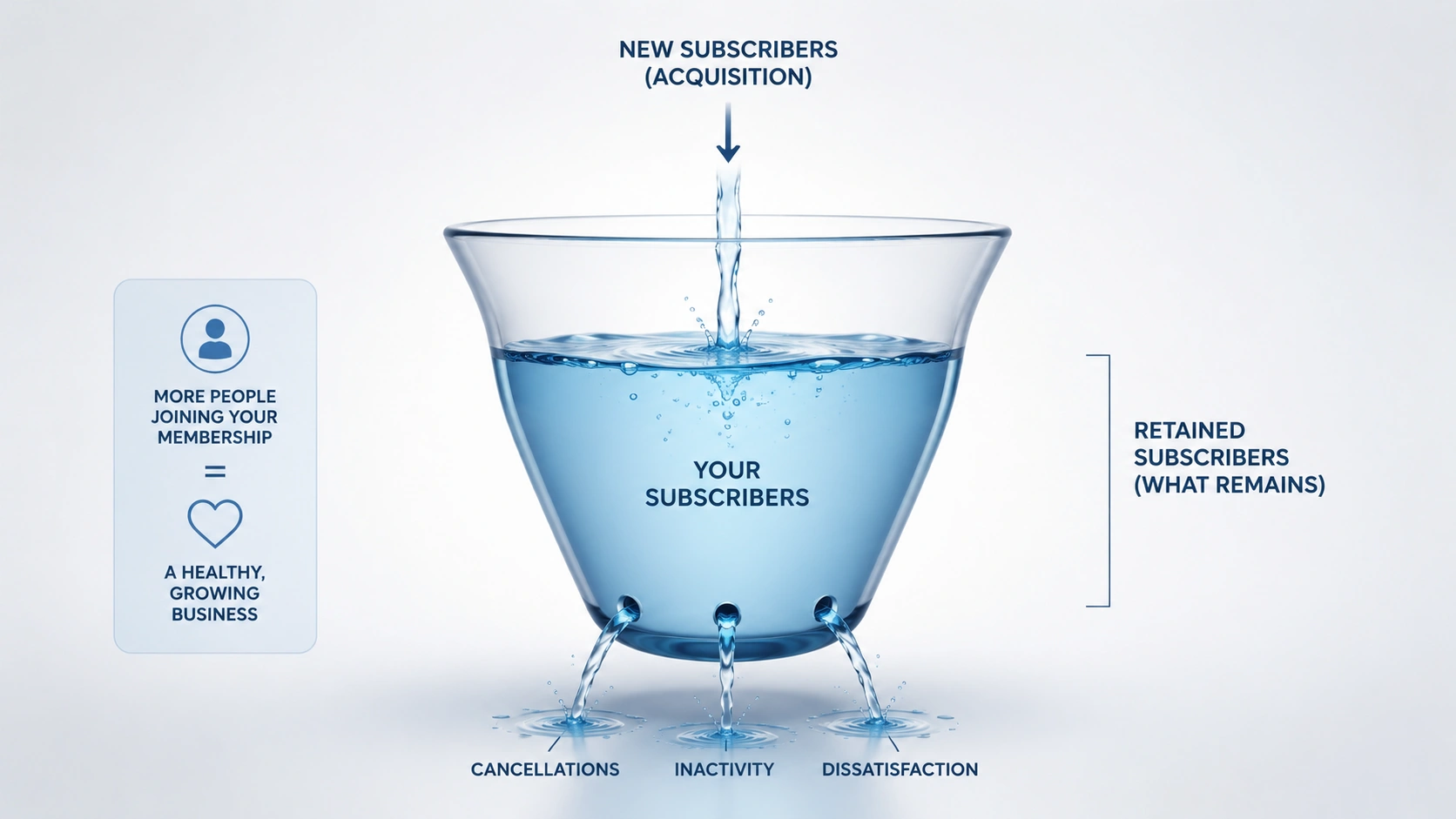
Your creator business can behave in much the same way.
New people entering your membership are important, but so are the people who have already decided to support you. If existing subscribers regularly leave, continually finding replacements can become an exhausting way of maintaining a business.
This does not mean acquisition is unimportant. You need new people discovering your work.
It means that, as your business develops, acquisition and retention need to work together.
A creator who attracts twenty new subscribers and keeps eighteen of them has a very different business from one who attracts twenty and loses sixteen.
The difference is not necessarily how talented either creator is.
It may simply be what happens after someone subscribes.
What subscriber retention actually means
Subscriber retention is simply the ability to keep people subscribed over time.
That sounds straightforward, but it is worth looking beyond the number itself.
Retention is not about persuading somebody to remain subscribed when they no longer want to be. Nor is it about making cancellation difficult.
Good retention comes from creating an experience where a subscriber continues to feel that staying is worthwhile.
That distinction matters.
A subscriber may remain because they genuinely enjoy your content, appreciate your personality, like having something to look forward to, value your archive, or simply feel that your membership has become a small and enjoyable part of their routine.
Those are very different reasons from feeling trapped into continuing a subscription.
The aim should therefore not be to make cancellation difficult.
The aim is to make continuing to subscribe feel naturally worthwhile.
Why people cancel
There is no single reason why someone cancels a subscription.
Sometimes the reason really is financial. Circumstances change, priorities change, and a subscription that once felt affordable may no longer fit someone's budget.
Sometimes someone simply loses interest.
Sometimes they have subscribed because of a particular piece of content or promotion and discover that the ongoing experience is not quite what they expected.
Other cancellations may have very little to do with the creator at all.
A subscriber might become busier, change their spending habits, take a break from social media or simply decide they are supporting too many creators at once.
This is important because it prevents you from interpreting every cancellation as a criticism of your work.
At the same time, patterns in cancellations can contain useful information.
If one person leaves, there may be nothing to learn from it.
If a large number of people repeatedly leave after the same period, or following the same type of experience, that deserves closer attention.
Some common areas worth considering include:
- Expectation mismatch: the experience inside the membership does not match what the subscriber thought they were joining.
- Inconsistent activity: the creator is highly active for a short period and then disappears for extended periods.
- Unclear value: subscribers struggle to understand what they are receiving on an ongoing basis.
- Content overload: there is plenty of material, but finding something worthwhile becomes difficult.
- Lack of connection: the membership begins to feel like a stream of transactions rather than a space with some personality behind it.
- Changing circumstances: the subscriber's own financial situation, interests or priorities have changed.
None of these automatically means that something is wrong with your business.
They are simply useful questions to ask.
Retention starts before someone subscribes
It is tempting to think of retention as something that begins after a person becomes a paying subscriber.
In reality, it begins much earlier.
The expectations created by your public content influence what someone anticipates when they arrive at your membership.
If your public presence suggests one kind of experience but your private space provides something completely different, the subscriber may feel disappointed even if the content itself is perfectly good.
This is why consistency between your public identity and your private offering matters.
Your public content does not need to reveal everything.
In fact, creating curiosity is often useful.
But the overall tone, personality and promise should make sense when somebody takes the next step.
A person should not have to wonder whether they subscribed to the right creator.
People subscribe for more than content
One of the easiest assumptions to make is that subscribers are simply paying for access to a collection of photos or videos.
Content is obviously important.
But the perceived value of a membership can be much broader.
People may value:
- having something new to discover regularly;
- access to a growing archive;
- the personality and atmosphere surrounding the creator;
- feeling part of a more private space;
- behind-the-scenes material and context;
- the sense that they are supporting someone whose work they enjoy;
- occasional interaction or acknowledgement;
- knowing what to expect when they return.
None of these requires you to become permanently available or provide unlimited access to your personal life.
That is an important distinction.
Connection does not require constant access.
A creator can be warm, personable and appreciative while still maintaining sensible boundaries.
The four pillars of retention
Although every creator business is different, several principles repeatedly influence whether a membership feels worthwhile over time.
Four are particularly useful to consider:
1. Predictability
Subscribers generally benefit from knowing that something is happening.
That does not necessarily mean publishing every day.
A realistic rhythm that you can maintain for months is usually more useful than an ambitious schedule that lasts two weeks.
For example, if you know that you can comfortably create two substantial pieces of content each week, that may provide a much stronger foundation than promising daily updates and constantly struggling to keep up.
Predictability creates a sense of reliability.
The subscriber knows that when they return, there is likely to be something there.
That simple expectation can become part of their routine.
2. Discoverability
A large archive sounds valuable until a new subscriber opens it and has no idea where to start.
If everything is presented as one enormous chronological stream, older content can become effectively invisible.
A well-organised archive changes that.
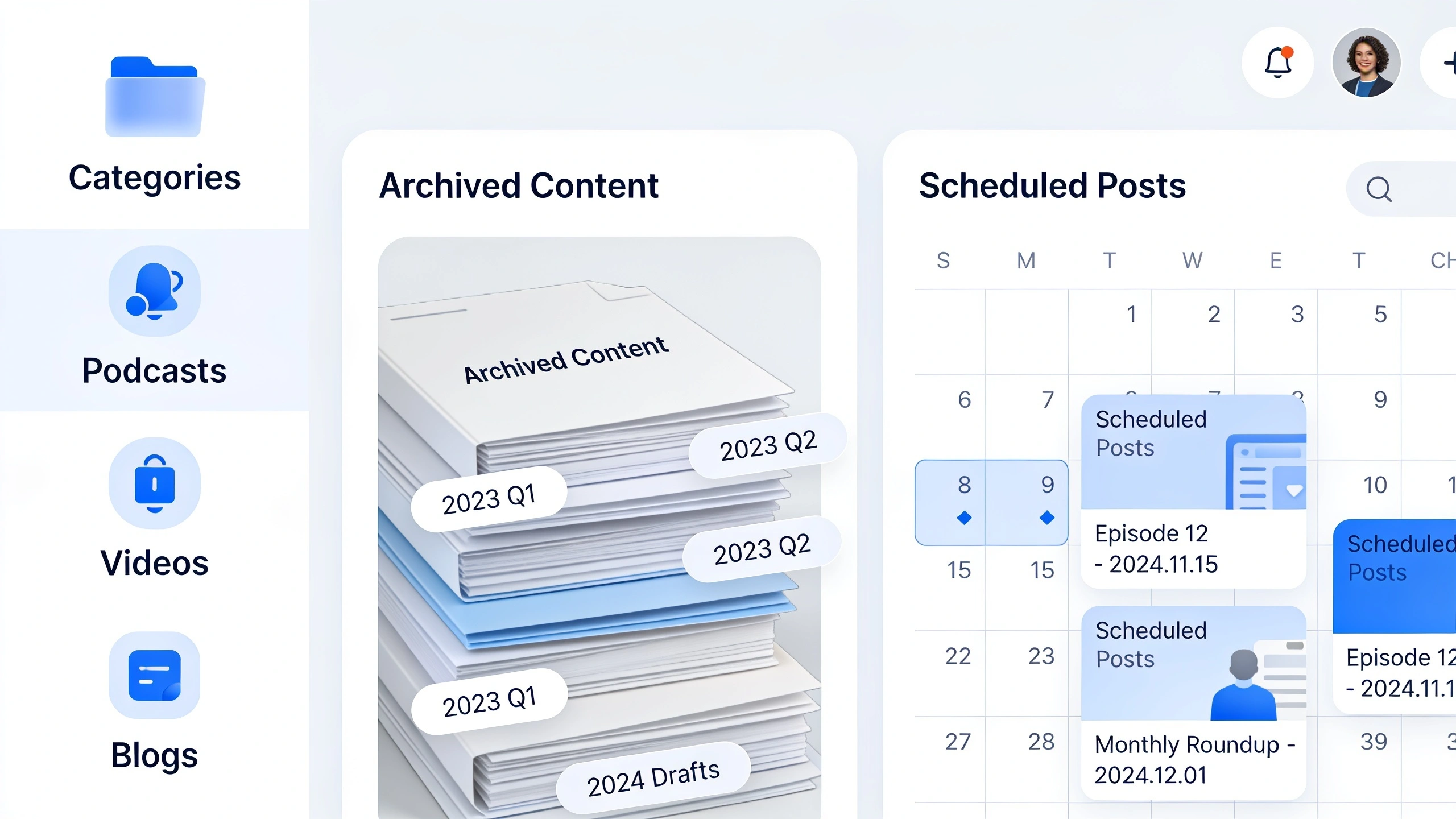
Clear categories, useful labels, pinned posts and collections can help a new subscriber discover material that existed long before they joined.
The archive then becomes part of the product rather than merely a pile of old posts.
3. Connection
People often want to feel that there is a real person behind the account.
That does not mean responding instantly to every message.
It might be as simple as acknowledging your supporters, asking for opinions, sharing an occasional behind-the-scenes thought or explaining what you are working on.
Small moments of genuine personality can make a digital membership feel considerably less anonymous.
At the same time, boundaries matter.
Trying to create a personal relationship with every subscriber individually can quickly become impossible. A sustainable approach is to create connection through the membership as a whole while deciding carefully how much one-to-one interaction you can realistically offer.
4. Ongoing value
A subscriber needs a reason to look forward to remaining subscribed.
That reason can evolve.
Perhaps your archive continues to grow. Perhaps you introduce new themes, occasional special projects or regular features. Perhaps your personality and creative development are themselves part of what people enjoy following.
The important point is that value does not have to mean more and more content.
It means giving people worthwhile reasons to return.
Predictability is not the same as repetition
There is an important difference between consistency and doing exactly the same thing every week.
A predictable structure can actually give you more creative freedom.
If subscribers know that certain types of content appear regularly, you have created a framework within which you can experiment.
For example, you might have a familiar weekly feature alongside less predictable projects.
The structure provides continuity while the new material provides surprise.
That combination can be much more sustainable than trying to reinvent your entire membership every time you publish something.
The danger of confusing volume with value
When retention becomes a concern, the instinctive response is often to create more.
More photos.
More videos.
More posts.
More messages.
More rewards.
More promises.
It feels logical.
If people are leaving because they do not see enough value, surely giving them more value must solve the problem.
The difficulty is that volume and value are not the same thing.
Imagine opening a library and finding ten thousand books scattered across the floor.
There may be enormous value inside that room, but finding the book you actually want could be exhausting.
The same thing can happen inside a creator membership.
A constant stream of unstructured material may eventually create choice overload rather than increasing satisfaction.
A smaller, better-organised library can sometimes feel considerably more valuable than a larger but chaotic one.
This is why retention is partly an organisational problem.
Your creative output may already contain plenty of value.
The challenge may be helping subscribers recognise it.
The first few days matter
The period immediately after someone subscribes deserves particular attention.
A new subscriber has just made a decision to support you. They are interested, curious and probably looking around to understand what they have joined.
If they arrive in an unfamiliar space and immediately encounter hundreds of posts with no obvious starting point, some of that initial enthusiasm can disappear.
A simple welcome experience can make a significant difference.
It might explain:
- where a new subscriber should begin;
- what types of content are available;
- how often you normally publish;
- where to find particularly popular or representative material;
- how to contact you or interact appropriately;
- what they can reasonably expect from their membership.
This does not need to be elaborate.
The objective is simply to remove uncertainty.
When someone knows how the space works, they can begin enjoying it rather than spending their first few days trying to work it out.
Do not make new subscribers feel like they arrived late
There is another benefit to a well-organised archive.
A person joining today should not feel as though they have missed everything.
If the best material is buried beneath months of posts, a new subscriber may assume that the real value was available to people who joined earlier.
A curated archive changes the perception.
Instead of thinking, "I missed all of this", the subscriber can think, "There is loads here for me to explore."
That difference matters.
Your existing library can therefore continue working for you long after the original publication date.
Retention is also about removing friction
Sometimes the best retention improvement is not adding something at all.
It is removing something that makes the experience unnecessarily difficult.
Consider the small obstacles a subscriber might encounter:
- They cannot find older content.
- They do not know what to expect next.
- They receive too many notifications.
- They are unsure where particular content belongs.
- They repeatedly encounter broken links.
- They have to search through unrelated posts to find useful information.
None of these problems is dramatic.
But every small frustration gives someone another reason to decide that the membership is not worth maintaining.
Good retention therefore involves asking not only, "What else can I give people?"
It also involves asking, "What could I make easier?"
Do not promise more than you can sustain
One of the easiest ways to create retention problems is to make ambitious promises when you are feeling particularly motivated.
You might announce daily updates.
You might promise a new series every week.
You might introduce several different content tiers.
At the time, the commitment feels manageable because you are thinking about the excitement of starting something new.
Several months later, however, that same promise can become a source of pressure.
A subscriber does not know how motivated you were when you made the promise. They simply know what they have come to expect.
That is why sustainable retention starts with realistic expectations.
It is much better to establish a publication rhythm that feels almost too easy to maintain than one that requires you to work at maximum capacity every week.
A useful question is:
"Could I realistically maintain this if I had a difficult month?"
If the answer is no, the system probably needs simplifying.
Consistency creates trust
Consistency is sometimes misunderstood as producing exactly the same amount of content forever.
It is better understood as reliability.
Your subscribers should gradually develop an understanding of what being a member means.
Perhaps they know there will normally be several updates each week.
Perhaps you have a regular feature that appears at a particular time.
Perhaps you occasionally release larger projects rather than publishing something every day.
The exact structure does not matter nearly as much as whether it is credible and repeatable.
Over time, this creates trust.
The subscriber does not have to wonder whether you have disappeared, whether their membership is still active in practice, or whether the experience they enjoyed when they joined has quietly changed.
That sense of reliability can be surprisingly valuable.
Creating value without creating more work
If you want subscribers to stay longer, it is tempting to think that every improvement must involve creating another piece of content.
It does not.
Some of the most useful improvements can come from making better use of work you have already created.
For example, an existing archive could become more valuable through:
- better categorisation;
- curated collections;
- clearer descriptions;
- pinned introductions;
- regularly updated indexes;
- highlighting particularly popular older material;
- creating logical starting points for newer subscribers.
This is an important distinction.
Increasing perceived value does not always require increasing production volume.
Sometimes the opportunity is already sitting inside your existing library.
The archive becomes more valuable over time
A healthy creator archive can become one of the strongest retention assets you have.
Every new piece of content potentially adds another permanent element to the experience.
A subscriber who joined six months ago has access to everything that has been added since.
A subscriber who joins today may have immediate access to a much larger body of work than somebody who joined when you first started.
That creates a useful compounding effect.
Your business is not simply producing this week's content.
It is gradually building an asset that becomes more substantial over time.
This is another reason why organisation matters so much.
If your archive is difficult to navigate, much of that accumulated value remains hidden.
If it is easy to explore, older work can continue contributing to the perceived value of the membership long after its original publication.
Personality matters more than endless interaction
There is an understandable fear among creators that they need to maintain constant personal interaction to keep subscribers engaged.
That can become exhausting very quickly.
You do not need to spend your evenings having individual conversations with dozens or hundreds of people.
Your personality can come through in other ways.
A short explanation of what inspired a piece of content.
A behind-the-scenes update.
A question asking members what they would like to see.
A glimpse into the process behind a project.
A simple acknowledgement of your supporters.
These moments can make the membership feel human without turning your inbox into a second full-time job.
The goal is not to make every subscriber feel as though they have become your personal friend.
It is to make the experience feel as though it comes from a real person rather than an anonymous content delivery system.
Boundaries can actually improve the experience
It may seem counterintuitive, but strong boundaries can make a creator membership feel more professional.
If subscribers know when you normally respond, what kinds of interaction you offer and what is outside your working hours, expectations become clearer.
That benefits both sides.
You are less likely to feel overwhelmed.
Subscribers are less likely to interpret a delayed response as something being wrong.
Your personal life remains protected.
And the business becomes easier to operate consistently.
This is particularly important for creators whose work is closely connected to their personality or appearance.
The fact that people are subscribing to you does not mean that they are entitled to unlimited access to you.
Your audience can appreciate your work while you still retain a private life.
Exclusivity should mean something
Another factor that can influence retention is whether the membership genuinely feels different from your public presence.
This does not mean that everything outside the membership needs to be withheld.
Your public social channels can remain valuable in their own right.
They are where people discover you.
Your private membership should give existing supporters reasons to remain interested.
Those reasons might include:
- content that is not available publicly;
- longer or more complete versions of public projects;
- behind-the-scenes material;
- access to an expanding archive;
- additional context around your work;
- occasional member-focused projects or features.
The important principle is not simply "give subscribers more".
It is "give subscribers something meaningful that public followers do not receive."
That distinction helps prevent your membership from becoming little more than an extension of your promotional feed.
Curiosity is useful, but disappointment is not
There is a delicate balance between creating curiosity and creating unrealistic expectations.
Your public content can encourage people to wonder what lies beyond it.
That is a useful part of marketing.
But if your promotional material consistently implies something substantially different from what subscribers actually receive, the resulting curiosity can quickly turn into disappointment.
Retention therefore begins with an honest relationship between expectation and experience.
You want the person joining your membership to think:
"This is what I expected, and there is even more here than I realised."
Not:
"This isn't what I thought I was paying for."
That difference can have a much greater effect on long-term retention than another promotional Reel.
What happens when you need a break?
No creator can operate at full capacity indefinitely.
You may become ill.
You may have family commitments.
You may want to take a holiday.
You may simply reach the point where you need several days away from screens.
A retention strategy that only works when you are constantly producing is not particularly resilient.
This is where planning becomes valuable.
If you have a structured archive and some content prepared in advance, a short break does not necessarily mean that your membership suddenly becomes empty.
You may also be able to communicate planned periods of reduced activity clearly.
Most people understand that creators are human.
The problem is usually not taking a break.
The problem is disappearing without explanation after creating an expectation of constant activity.
A sustainable business should have enough structure to absorb occasional interruptions.
Do not panic when someone cancels
A cancellation can feel surprisingly personal.
Someone chose to support you, and now they have chosen to stop.
It is natural to wonder what you did wrong.
Sometimes, however, you did nothing wrong at all.
People cancel subscriptions for all sorts of reasons.
Their financial circumstances may have changed.
They may be reducing the number of subscriptions they maintain.
They may have less time.
Their interests may have changed.
They may simply have decided to spend their money elsewhere.
Trying to prevent every cancellation is therefore impossible.
The more useful objective is to identify patterns.
If one person cancels, take note and move on.
If twenty people cancel shortly after a particular change, investigate.
If cancellations consistently happen after long periods without new content, that tells you something useful.
If they increase after introducing a complicated new structure, that may also be worth examining.
The individual cancellation is not necessarily the lesson.
The pattern may be.
Use data as a question, not a verdict
Analytics can help you understand retention, but numbers do not explain themselves.
Suppose you notice that several subscribers tend to leave after three months.
That does not automatically tell you why.
Perhaps they have consumed the content they were most interested in.
Perhaps the onboarding experience needs improvement.
Perhaps the publishing rhythm changes around that point.
Perhaps the original promotion attracted people who were never particularly interested in becoming long-term supporters.
The useful response is not to stare at the number and invent an explanation.
It is to treat the number as a question.
"Why might this be happening?"
From there, you can look at your content, communication, subscriber experience and wider marketing activity to form a more informed picture.
That is a much healthier approach than allowing a single statistic to dictate your entire strategy.
Retention and acquisition should tell the same story
Your public marketing and your private membership are not separate businesses.
They are two parts of the same journey.
Public content creates awareness.
Your profile creates interest.
Your destination page helps someone understand the offer.
The membership delivers the experience.
Retention tells you whether that experience continues to provide enough value for people to remain.
If there is a significant disconnect between these stages, problems can appear anywhere along the journey.
For example, exceptionally strong promotional content may attract huge numbers of people, but if those people are not actually the right audience, subscription numbers may look impressive initially while retention remains poor.
Conversely, a smaller but highly relevant audience may produce fewer initial subscriptions while creating a much more stable membership over time.
That is why the biggest audience is not necessarily the healthiest audience.
The escalation trap
When retention falls, creators can easily enter a cycle of escalation.
The pattern often looks something like this:
- Subscribers begin cancelling.
- The creator assumes there is not enough content.
- More content is produced.
- The creator becomes increasingly busy.
- Quality or consistency begins to suffer.
- The creator becomes tired and less enthusiastic.
- The subscriber experience becomes less enjoyable.
- More subscribers leave.
- The creator responds by producing even more.

The cycle can continue until the business becomes unsustainable.
The solution is not necessarily to work harder.
Sometimes it is to step back and understand what is actually causing the problem.
More content can be useful when content genuinely is the missing piece.
But if the real issue is poor organisation, unclear expectations, inconsistent communication or a weak onboarding experience, producing another twenty posts will not solve it.
Retention is partly an operational problem
The psychology behind retention may be relatively simple.
Running it consistently is less so.
As a creator business grows, you may find yourself managing:
- content production;
- archive organisation;
- publication schedules;
- subscriber communication;
- onboarding information;
- public promotion;
- analytics;
- privacy and account security;
- backups and digital assets;
- future content planning.
None of these responsibilities necessarily requires enormous amounts of time individually.
Together, they can become a substantial operational workload.
This is one of the less obvious reasons why some creators struggle with retention even when they understand what subscribers want.
They know what a good experience should look like.
They simply do not have enough time to maintain all the systems required to deliver it consistently.
That is not a personal failure.
It is a normal consequence of a business becoming more complex.
Build systems around the parts that repeat
The answer is not necessarily to automate everything.
Some aspects of a creator business should remain personal.
But repetitive tasks are good candidates for systems.
A repeatable onboarding process.
A consistent content calendar.
A clear archive structure.
A standard approach to file naming.
Scheduled publication.
Regular analytics reviews.
A simple process for updating important information.
The benefit is not merely saving a few minutes here and there.
Good systems reduce the number of things you have to remember.
That reduces mental load.
And when your business requires less constant attention from you, it becomes much easier to maintain the quality of the subscriber experience.
Retention should make your business calmer, not more complicated
There is a danger in learning about retention.
You can become so focused on optimising every part of the subscriber experience that the business becomes another source of pressure.
You start tracking every cancellation.
Every post becomes a performance test.
Every quiet week feels like a warning.
Every subscriber who leaves becomes a problem that needs fixing.
That is not sustainable either.
Retention is useful because it helps you understand the health of your business.
It should not become an obsession.
You are still building a creative business for a reason.
The purpose of your systems is to support your work, not turn every interaction into a data point.
A useful way to think about subscriber value
One helpful mental shift is to stop asking:
"What can I give subscribers this week to make them stay?"
Instead, ask:
"What experience am I creating that makes people want to return?"
That question is broader.
It includes your content, but it also includes your organisation, communication, consistency, atmosphere and boundaries.
It encourages you to think beyond individual posts.
A subscriber does not experience your business as a spreadsheet of uploads.
They experience it as a whole.
That experience is what you are really trying to improve.
When outside support starts making sense
There eventually comes a point where the limiting factor may no longer be your creativity.
It may be your available time.
You might know exactly what you want your subscriber experience to look like, but lack the time to organise the archive, maintain the publishing schedule, monitor the surrounding systems and keep everything running smoothly.
That is often a useful point to reassess what you are personally responsible for.
You do not have to hand over your creative identity.
You do not have to give somebody else control of your relationship with your audience.
And you certainly do not have to outsource everything.
Sometimes the most valuable support is simply removing the operational work that repeatedly pulls you away from the parts of the business only you can do.
The important thing is to recognise the difference between needing to learn something and needing to personally perform every task.
Understanding how retention works gives you the ability to make good decisions.
It does not mean you have to spend your evenings becoming an expert in every system behind those decisions.
Final thoughts
Subscriber retention is not a trick for stopping people from cancelling.
It is the result of creating an experience that remains useful, enjoyable and worthwhile after the excitement of the initial subscription has passed.
That means setting realistic expectations.
It means being consistent without making unsustainable promises.
It means giving subscribers reasons to return without assuming that more content is always the answer.
It means making your archive easy to explore, creating genuine connection while protecting your boundaries, and paying attention to patterns without allowing every cancellation to undermine your confidence.
Most importantly, it means recognising that a healthy creator business is built over time.
New subscribers will always matter.
But the people who have already chosen to support you are part of the foundation on which the business is built.
The strongest memberships are not built by constantly asking people for one more month. They are built by creating an experience that makes another month feel worthwhile.